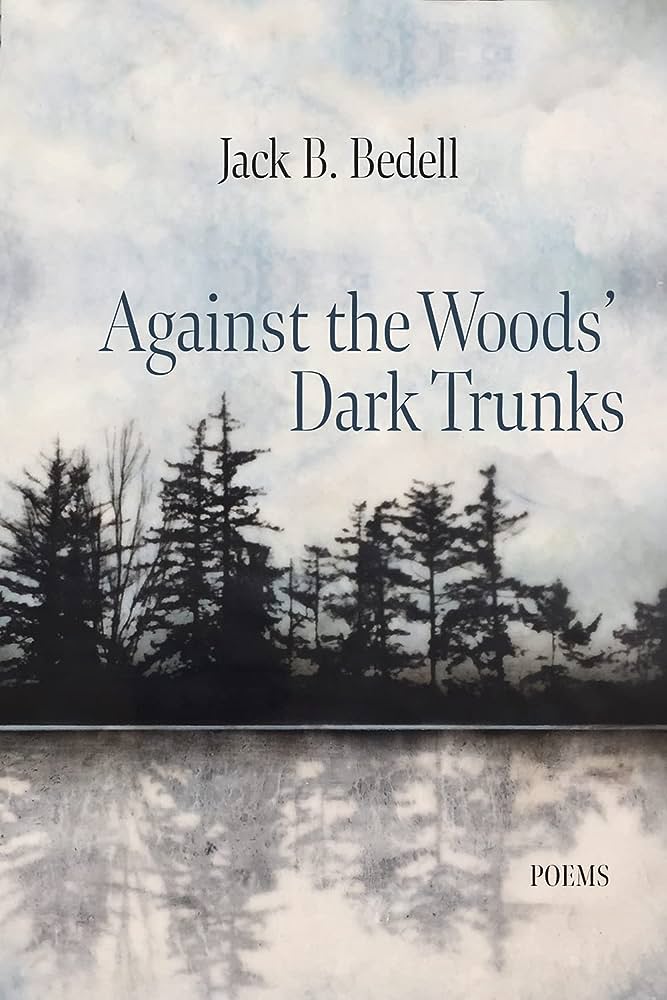
Against the Woods’ Dark Trunks: Poems by Jack B. Bedell
Published by Mercer University Press
***
Review by Glenn Barker
How much are we progressively refined into our final shape through our surroundings—in an osmosis of folklore, landscape, texture and tongue—to become fused with the woods, wilds and waters that surround us? Every place has a rhythm, feel and quality that weaves the backdrop and habits of culture—what makes meaning and purpose emerge within the peculiarities of place and person.
Against the Woods’ Dark Trunks (AWDT) is Jack B. Bedell’s instinctive exploration of South Louisiana, and the grounding influence of its vast, physical, and indescribable swamplands. Rooted within the landscape lie the physical dark woods, alien cypress trees and wetland wildlife; and the monsters that hide in the folds of our minds, amplified by our fear and foreboding of the unnatural that lurks in the shadows of the slow-moving bayou waters.
In this thematic narrative, he quietly taps us on the shoulder and draws us away from the stuff of daily life to the natural and supernatural, the physical and psychological that linger just beyond our attention.
In the opening poem, “Another Night, Just,” we are primed with the ordinary noise of the world, with “news of another mass shooting out West” and “the rush to get things ready for the ride to school”. So far, so familiar. Yet we are quickly drawn into something scratching at our unknowing, to the mysterious and unanswerable that lie just beneath the surface of the everyday.
“Iapetus” illustrates his regular narrative shift from the concrete to the formless:
“My daughter has slept all week / with a tiny jar of salt / under her pillow I brought back / from a trip to West Virginia. […] She wants to dream of serpents coils rolling / just under the water’s surface”.
And “Stink” is another poem that echoes that insistent shift from the distinct to the indistinct:
“The swamp smells heavy / like a soul tethered to the heat / dripping down every window. […] Easy to hit that smell and know / it’s been left by something old / as large as the trees themselves, / something dark at its core, / always moving / from home to home, lonely / as the moon against black sky.”
Throughout this collection he weaves fine examples of ekphrastic responses to artworks, and other landscape prompts, which act as a diorama, maybe shoebox size like “Burn, Hollywood, Burn,” to illuminate and emphasise the underlying narrative, steadily prompting us to become fused with the texture and feel of the landscape and the folk tales that haunt the Louisiana landscape and culture.
“Death Comes to the Banquet Table, ca. 1630-40” serves as an ekphrastic meditation on temporality, and swamp life:
“The last grain of sand drops / into the bottom of the glass / and it simply does not matter / that dessert has barely suffered / touch. […] Only so many grains / of sand exist, and Death’s hour glass / is smaller than anyone cares to admit.”
What lies beneath is a constant AWDT theme and persistent echo. We are reassured above the ground, above the waters; tentative at the edge, fearful of the depths and a dark animal spirit presence—as well as the bears and crocodiles.
And “Goujon” hits that particular spot perfectly:
“The old men will tell you, I am / waiting deep in the silt / under still waters. / You dream of meals / my thick body would yield. / Spread out your poles, / hooks, corks, frozen shrimp. / Nothing in your tackle box / can pull me from this mud. / My patience is black / as time itself.”
The final poem, “Neighbor Tones” takes us to the end of Jack’s story. We are far from home. A quote from John Coltrane of the musician’s role to “get closer to the sources of nature, […] in communion with the natural laws” takes us right to the existential edge of this collection:
“How much of ourselves / do we leave with each other […] We share the breeze, the noise / it carries. The space between us, / never empty, is full of us.”
This collection is shot through with the symbolism that lingers at the edge of the swamp; of family and tradition written amid the wide and ominous horizon of a waterlogged landscape. His imagery is sharp and profoundly sensory, with a subtle underlying narrative that peels away the layers of normality, pulling us into the delta to reflect its unstable state of shifting sands and wildlife to emerge unsettled, a reflection perhaps of our own precarious existence.
This is not a collection to be read in one sitting. Take your time to absorb the layers of this haunting and resonant meditation and allow yourself to be transported by the slow persistent pull of the swamps and the ancient call to our watery origins, just for a while anyway.
***

Jack B. Bedell is Professor of English and Coordinator of Creative Writing at Southeastern Louisiana University where he also edits Louisiana Literature and directs the Louisiana Literature Press. Jack’s work has appeared in HAD, Heavy Feather, Pidgeonholes, The Shore, Moist, Autofocus, EcoTheo, The Hopper, Terrain, and other journals. He’s also had pieces included in Best Microfiction and Best Spiritual Literature. His latest collection is Against the Woods’ Dark Trunks (Mercer University Press, 2022). He served as Louisiana Poet Laureate 2017-2019.
 eastridgereview.com